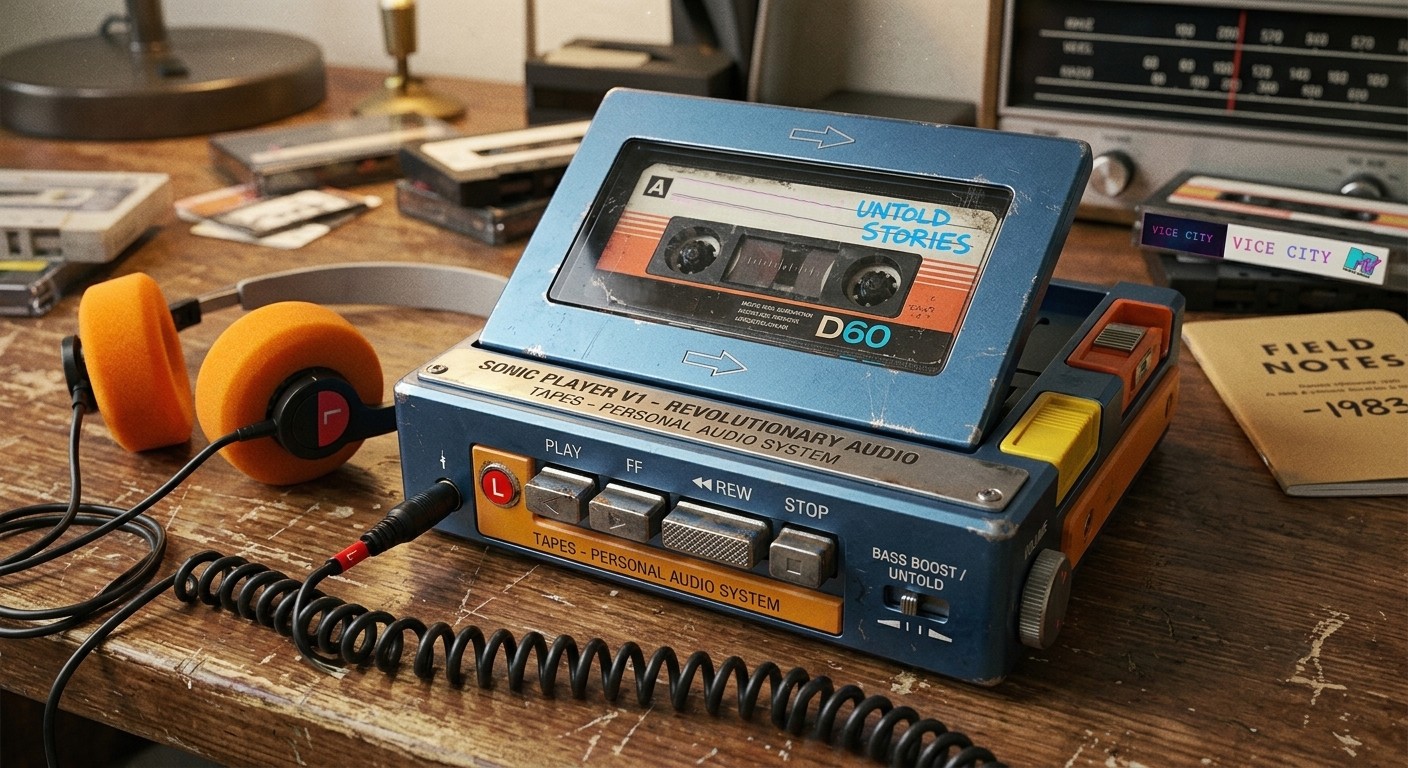
Imagine stepping onto a busy city street in 1983. Cars rush past, arcade machines echo from nearby shopping centres and someone walks by wearing bright blue headphones connected to a strange silver box clipped to their belt. For the first time in history, music wasn't something people only enjoyed at home or in the car—it had become completely personal. That little silver box was the Sony Walkman, and it would become one of the most influential gadgets ever created.
A Crazy Idea
In the late 1970s Sony co-founder Masaru Ibuka wanted a lightweight cassette player he could use while travelling. Existing portable cassette recorders were bulky and designed for journalists rather than music lovers. Sony engineers removed the recording hardware from one of their portable tape recorders, making it lighter, smaller and focused entirely on playback. Many executives believed it would fail. After all, who would buy a cassette player that couldn't even record?
💡 Did You Know?
The original Walkman (TPS-L2) featured two headphone sockets, allowing two people to listen together using a special "Hotline" button that temporarily lowered the music volume so they could talk.
The Launch
The Walkman launched in Japan on July 1, 1979. Sony initially expected modest sales. Instead demand exploded. Young people loved the freedom of carrying their favourite albums wherever they went. Within months the Walkman became a cultural phenomenon.
"Music had become mobile for the first time."
The Soundtrack of the 1980s
By the early 1980s the Walkman had become more than a gadget. It was a fashion accessory. Whether you were jogging through the park, travelling on a train or relaxing at the beach, wearing those bright orange foam headphones became a symbol of modern life. Pop stars embraced it. Teenagers carried mixtapes everywhere. Entire friendships were built around swapping cassette tapes packed with favourite songs.
Why Everyone Loved Mixtapes
The Walkman and the mixtape were inseparable. Instead of listening to an entire album, people could create their own playlists long before Spotify existed. Recording songs from the radio required patience, timing and a bit of luck. If the DJ talked over the intro... you simply lived with it. That imperfection became part of the charm.
📼 Classic Mixtape Tracks
- Take On Me – a-ha
- Billie Jean – Michael Jackson
- Sweet Dreams – Eurythmics
- Girls Just Want To Have Fun – Cyndi Lauper
- Don't You (Forget About Me) – Simple Minds
The Competition Arrives
The Walkman's success inspired dozens of rivals. Panasonic. Aiwa. Toshiba. Sharp. Nearly every electronics company launched its own portable cassette player. Yet the name "Walkman" became so famous that many people used it to describe every portable cassette player regardless of the manufacturer.
Changing the Way We Exercise
Before the Walkman, jogging was often a quiet activity. The ability to run while listening to your favourite music transformed fitness forever. Portable music players helped fuel the jogging boom that defined much of the 1980s. Today every smartphone owes something to that original idea.
The End of an Era
The arrival of CDs during the late 1980s eventually led to the Discman. Later came MP3 players. Then Apple's iPod. Finally smartphones replaced dedicated music players almost entirely. Yet millions of people still remember the satisfying click of inserting a cassette and pressing Play.
The Walkman's Legacy
The Walkman sold hundreds of millions of units across numerous generations and forever changed how people consumed music. More importantly, it introduced the idea that technology could be personal. Without the Walkman there may never have been the iPod, wireless earbuds or streaming music as we know it today. Few inventions can claim to have changed everyday life so completely.
⭐ Vice City Vibe Rating
Cultural Impact: ⭐⭐⭐⭐⭐ Nostalgia: ⭐⭐⭐⭐⭐ Cool Factor: ⭐⭐⭐⭐⭐ One of the defining inventions of the 1980s.