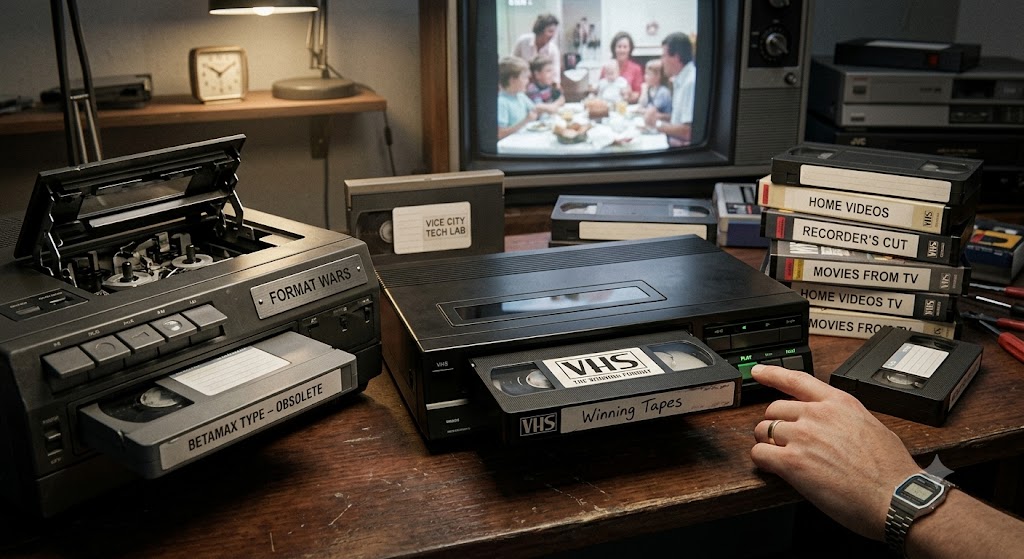
Long before Netflix, DVDs, streaming services, or even the internet, families gathered around bulky televisions with one goal: watching movies whenever they wanted. That simple idea sparked one of the greatest technology battles ever fought. In one corner stood Sony's sleek, high-quality Betamax. In the other was JVC's less glamorous but more practical VHS. Only one could become the standard in homes around the world.
The Birth of Home Video
In the early 1970s, recording television at home sounded almost futuristic. If you missed your favourite programme, it was simply gone unless the broadcaster repeated it. Home video promised something revolutionary: the ability to record shows and watch films whenever you pleased.
Electronics manufacturers knew whoever dominated this market could define the future of home entertainment. The race was on.
Betamax Arrives First
Sony introduced Betamax in 1975. It was compact, beautifully engineered and produced excellent picture quality. Early reviewers praised the sharp image and Sony believed its new format would quickly become the industry standard.
But there was one problem. The original Betamax tapes could only record around one hour of video. That was enough for many television programmes, but it couldn't comfortably fit a full-length movie or many sporting events.
VHS Enters the Fight
A year later, JVC launched the Video Home System—better known as VHS.
Although many enthusiasts agreed that Betamax produced a slightly sharper picture, VHS had a huge advantage. Its tapes could record significantly longer. Consumers cared less about tiny differences in picture quality and more about recording an entire football match or a Hollywood blockbuster without changing tapes.
Did You Know?
The initials VHS stand for Video Home System, while Beta was simply the name Sony chose for its cassette format.
The Real Reason VHS Won
Many people assume VHS won because it was technically superior. Ironically, that wasn't really the case.
Instead, VHS succeeded because of business decisions.
JVC licensed VHS technology to numerous manufacturers, allowing companies such as Panasonic, Sharp, Hitachi and many others to produce VHS machines. This created fierce competition, which pushed prices down and filled store shelves with affordable VHS players.
Sony kept much tighter control over Betamax production, meaning there were fewer manufacturers and generally higher prices.
Consumers voted with their wallets.
The Video Rental Explosion
As video rental stores appeared across towns and cities during the 1980s, another advantage emerged.
Rental shops naturally stocked the format most customers owned. As more households bought VHS players, stores ordered more VHS movies. That encouraged even more people to purchase VHS recorders, creating a powerful cycle that became almost impossible for Betamax to break.
Within only a few years, VHS had become the dominant choice in rental stores worldwide.
"Sometimes the better technology doesn't win—the one that reaches the most people does."
Was Betamax Actually Better?
For decades, technology enthusiasts have debated this question.
Many experts still argue that Betamax delivered slightly cleaner images and better colour reproduction than early VHS recordings. However, those differences became less important as VHS technology improved throughout the 1980s.
To the average family watching films on a 21-inch CRT television, convenience mattered far more than tiny improvements in picture quality.
The End of the Format War
By the late 1980s, the battle was effectively over. VHS dominated homes, rental stores and electronics shops around the world. Even Sony eventually began producing VHS recorders alongside Betamax machines.
Although Betamax continued to exist in specialist broadcasting and professional television production for many years, its dream of becoming the world's home video standard had disappeared.
The Legacy Today
The VHS vs Betamax rivalry became the blueprint for countless technology battles that followed. DVD fought LaserDisc, Blu-ray challenged HD DVD, and modern streaming platforms continue to compete for viewers' attention.
The lesson remains surprisingly relevant: the best technology doesn't always become the most successful. Pricing, availability, partnerships and convenience often matter just as much as technical excellence.
Today, VHS tapes have become nostalgic collector's items, while vintage video rental stores live on mostly in memories. Yet every time we choose between competing technologies, we are witnessing echoes of the format war that captivated the 1980s.