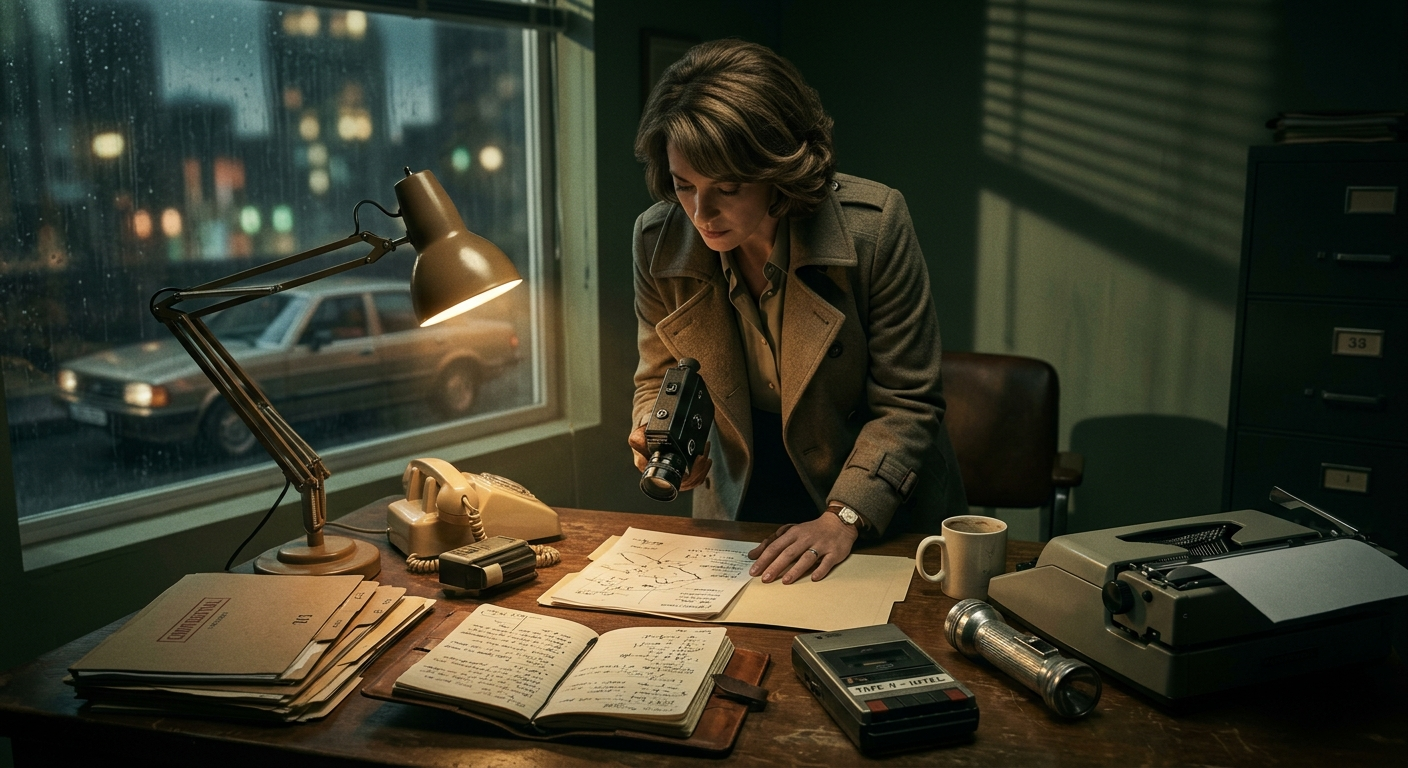
In the world of 1980s television, secret agents were usually expected to be cool, confident, and surrounded by sophisticated technology. Scarecrow and Mrs. King took a very different approach. Instead of building its story around an invincible spy, the CBS series paired an experienced intelligence operative with an ordinary suburban mother who had absolutely no intention of becoming a spy.
The result was a wonderfully unusual mixture of espionage, comedy, family drama, action, and romance. Lee Stetson and Amanda King began as complete strangers, but their accidental partnership gradually became one of the show's biggest attractions. Behind the disguises, international intrigue, and occasional explosions was a much simpler story about two very different people learning to trust one another.
A Very Unusual Beginning
Scarecrow and Mrs. King premiered on CBS on October 3, 1983. Created by Brad Buckner and Eugenie Ross-Leming, the series immediately established a premise that separated it from many of the spy dramas of the period.
Lee Stetson, known by the code name "Scarecrow", was an experienced operative working for a secret U.S. intelligence organization. Amanda King, meanwhile, was a divorced mother living in Arlington, Virginia, whose biggest concerns appeared to be her children, her home, and everyday suburban life.
Their lives collided at a train station when Lee, attempting to escape people pursuing him, handed Amanda a mysterious package and asked her to deliver it to a man in a red hat. Amanda had no idea what she had been dragged into. Unfortunately for her, simply possessing the package was enough to put her in danger.
💡 Did You Know?
The show's entire premise grows out of that chance encounter. Amanda isn't recruited after years of training or secretly revealed to be an expert agent. She is simply in the wrong place at the wrong time, and Lee has no choice but to involve her in the increasingly complicated situation.
Meet Amanda King
Kate Jackson played Amanda King, bringing an established television star to the role. Jackson was already famous for playing Sabrina Duncan in Charlie's Angels, but Amanda was a very different kind of character.
Amanda was intelligent without being portrayed as a superhuman action hero. She was observant, practical, quick-thinking, and accustomed to solving everyday problems. Those qualities turned out to be surprisingly useful when she found herself dealing with spies and international criminals.
Amanda was also a mother first. She lived with her mother, Dotty West, and raised her two sons, Philip and Jamie. Her domestic responsibilities remained an important part of the series, giving the show a distinctive contrast between ordinary family life and extraordinary assignments.
That contrast became one of the show's secret weapons. Amanda could be dealing with an international security crisis one moment and worrying about her children's school or explaining her absence to her mother the next.
Enter the Scarecrow
Bruce Boxleitner played Lee Stetson, the experienced operative whose code name gave the series its first half of its title. Lee was initially reluctant to work with Amanda. From his perspective, she was an untrained civilian who had accidentally become involved in an intelligence operation.
Lee's background was almost the complete opposite of Amanda's. He was accustomed to operating undercover, handling dangerous assignments, and relying on his own instincts. He also had a reputation as something of a lone wolf.
Amanda gradually changed that. Rather than becoming a copy of Lee, she developed her own way of handling the Agency's dangerous situations. Her ability to read people, notice details, and think calmly when circumstances became chaotic frequently proved just as valuable as Lee's professional training.
The relationship between the two characters developed slowly. What began as an inconvenient partnership became friendship, then trust, and eventually something much deeper.
Inside the Agency
Lee's mysterious workplace was known simply as the Agency, with its operations hidden behind the cover of I.F.F., International Federal Film. The fictional organization provided the show with an endless supply of missions, unusual assignments, dangerous enemies, and elaborate cover stories.
At the centre of the Agency was Mel Stewart as Billy Melrose, Lee's supervisor and one of the people responsible for keeping the increasingly complicated operation under control.
Martha Smith played Francine Desmond, another Agency operative whose relationship with Amanda evolved throughout the series. Francine initially viewed Amanda's lack of formal training with considerable scepticism, providing plenty of opportunities for rivalry and comedy.
Away from the Agency, Beverly Garland played Amanda's mother, Dotty West. Dotty was not an intelligence officer, but her curiosity created its own problems. Amanda's increasingly unusual excuses for disappearing from home made it harder and harder to keep her secret life hidden.
Amanda's family also included her sons, Philip and Jamie King, played by Paul Stout and Greg Morton. Sam Melville appeared as Joe King, Amanda's former husband and the father of her children.
🎬 Behind the Scenes
Kate Jackson was more than the star of the series. She also co-produced the show with Warner Bros. Television through her production company, Shoot the Moon Enterprises, giving her a role in the production as well as in front of the camera.
When Espionage Meets Suburbia
The most distinctive feature of Scarecrow and Mrs. King was the way it constantly placed the extraordinary next to the ordinary.
Amanda could find herself involved in an international operation and then have to return home and convince Dotty that everything was perfectly normal. Lee could spend one part of an episode dealing with a dangerous enemy agent and the next helping Amanda maintain a believable cover story around her family.
That mixture gave the series a lighter personality than many traditional espionage dramas. It also allowed the writers to explore something that most spy shows largely ignored: what happens when secret-agent work collides with school runs, family dinners, neighbours, and suburban routines.
Amanda's transformation was gradual. She didn't suddenly become an expert operative overnight. Instead, the audience watched her gain experience with each assignment, becoming more confident and increasingly comfortable working alongside Lee.
Eventually, the woman who had originally been an accidental participant became a genuine member of the Agency team. That progression gave the series an ongoing sense of development rather than simply repeating the same premise every week.
Cars, Chases and Cold War Adventures
Despite its domestic comedy, Scarecrow and Mrs. King never forgot that it was an action-adventure series. Lee's assignments could involve international criminals, assassins, stolen information, political intrigue, undercover operations, and the ever-present tensions of the Cold War.
The show also embraced the visual language of 1980s television. Cars, disguises, surveillance equipment, secret meetings, government files, and covert exchanges all became familiar parts of the series.
Lee's distinctive Corvette became one of the memorable vehicles associated with the character, while the series regularly used car chases and action sequences to move its stories along.
At the same time, the show rarely allowed the action to overwhelm the characters. The stakes could be serious, but the tone generally remained accessible and often playful.
Composer Arthur B. Rubinstein supplied the series' music, helping establish the combination of adventure, suspense, and romance that became part of its identity.
From Partners to Something More
The growing relationship between Amanda and Lee was always one of the show's central attractions. Their romance wasn't rushed. Instead, it developed through dozens of missions in which they gradually learned how much they could rely on each other.
Amanda had other relationships during the series, and Lee had his own romantic complications, but neither could quite escape the bond developing between them.
The important thing was that their relationship grew out of their partnership. Lee learned to respect Amanda's judgement, while Amanda came to understand the risks and responsibilities that came with Lee's profession.
❤️ Love and Espionage
Lee and Amanda's long-awaited wedding storyline arrives in the fourth season. The episode Do You Take This Spy? originally aired on February 13, 1987, and centres on an international crime case that threatens to interfere with their wedding plans. The pair ultimately move forward with their marriage, giving fans the payoff that the series had been building toward for years.
Bringing the two leads together could easily have removed the tension that had driven the romance for so long. Instead, the series found new complications in their relationship, particularly because their professional lives were anything but ordinary.
The result was a partnership that felt different from the typical television romance. Lee remained the experienced operative, while Amanda continued to bring her own instincts and perspective to their assignments.
A Difficult Final Season
The fourth season brought an unexpected challenge that had nothing to do with the show's fictional world.
In January 1987, Kate Jackson underwent her first mammogram and was diagnosed with a small malignant breast tumour. She underwent a lumpectomy and returned to work about a week later, continuing to film while undergoing a course of radiation treatment.
The production schedule was rearranged to accommodate Jackson's treatment. The circumstances were kept largely private at the time, making her decision to continue working while undergoing treatment particularly remarkable.
🎙️ A Remarkable Return to Work
Jackson's treatment took place while Scarecrow and Mrs. King was still in production. According to accounts of the period, she returned to the series soon after surgery and worked through five weeks of radiation treatments.
The season continued with Lee and Amanda facing new cases and increasingly complicated personal circumstances. The series remained focused on the combination that had always made it distinctive: espionage on one side and the characters' personal lives on the other.
Scarecrow and Mrs. King ultimately concluded on May 28, 1987, after four seasons and 88 episodes. Its final chapter brought the series' run to an end after nearly four years on CBS.
Why the Formula Worked
At first glance, the premise of a professional spy partnering with a suburban mother might have sounded like a novelty. In practice, it gave the writers an enormous amount of room to explore different types of stories.
One week could deliver a traditional spy adventure. Another could lean heavily into comedy. A third might concentrate on Amanda's family or the evolving relationship between the two leads.
That flexibility helped the show avoid becoming just another Cold War thriller. The espionage provided excitement, but the characters gave viewers a reason to keep coming back.
Amanda also offered an unusual perspective on the spy world. She didn't enter it with years of training or a military background. Her strength came from qualities that were often associated with everyday life: patience, observation, empathy, adaptability, and the ability to improvise.
Could Amanda King Be a Spy Today?
One of the fun things about looking back at Scarecrow and Mrs. King is seeing just how much the world of espionage has changed.
The show's Cold War adventures relied on physical documents, film, surveillance equipment, coded messages, disguises, telephone calls, and face-to-face meetings. Today, fictional spies are just as likely to be dealing with cyberattacks, digital surveillance, encrypted communications, satellite imagery, and enormous amounts of computer-generated information.
🔍 Then vs. Now
- 📼 Film and physical documents vs. 💾 Digital files and encrypted storage
- 📻 Radio communications vs. 📱 Encrypted digital messaging
- 🗺️ Paper maps and dead drops vs. 🛰️ GPS and satellite technology
- 💼 Physical disguises and passports vs. 👤 Digital identities and biometric systems
- 🕵️ Traditional surveillance vs. 📷 Networked cameras and facial recognition
The technology has changed dramatically, but the human side of intelligence work remains familiar. Reading people, noticing unusual behaviour, building trust, and making decisions under pressure are skills that don't become obsolete.
That is where Amanda's character still feels surprisingly relevant. She succeeded not because she was the most technologically sophisticated person in the room, but because she understood people and paid attention to details others sometimes overlooked.
A modern version of Amanda might be juggling family responsibilities with smartphones, video calls, digital security, and a completely different set of threats. The technology would change, but the basic character could remain remarkably recognisable.
The Lasting Legacy
More than four decades after its debut, Scarecrow and Mrs. King remains an especially distinctive piece of 1980s television. It wasn't the darkest spy drama of its era, nor was it simply a sitcom with secret agents. Its appeal came from the space between those two worlds.
The series understood that audiences could enjoy an exciting chase or dangerous mission while still caring about what happened when the characters went home.
Amanda's family, Dotty's curiosity, Billy's attempts to keep the Agency functioning, Francine's rivalry with Amanda, and Lee's gradual transformation from solitary operative to devoted partner all helped create a world that felt larger than its weekly assignments.
✨ A 1980s Time Capsule
For anyone interested in the decade, the series also offers a generous helping of 1980s atmosphere. The cars, clothing, hairstyles, technology, homes, workplaces, and suburban settings make it an entertaining snapshot of the period as well as an adventure series.
Kate Jackson and Bruce Boxleitner were at the centre of it all. Their performances gave the unlikely premise credibility and allowed the relationship between Amanda and Lee to develop naturally over four seasons.
What began with a mysterious package at a train station eventually became a story about trust, friendship, family, loyalty, and love—with a healthy dose of Cold War espionage thrown in for good measure.
That combination is what makes Scarecrow and Mrs. King so much fun to revisit. It reminds us that television espionage doesn't always need to be grim or ultra-serious. Sometimes the most memorable spy story is the one where the secret agent has to save the world and his partner still has to get home in time for dinner.
💬 Community Discussion
Share your memories of the 80s. Every comment is reviewed before appearing.
Leave a Comment
💬 Recent Comments