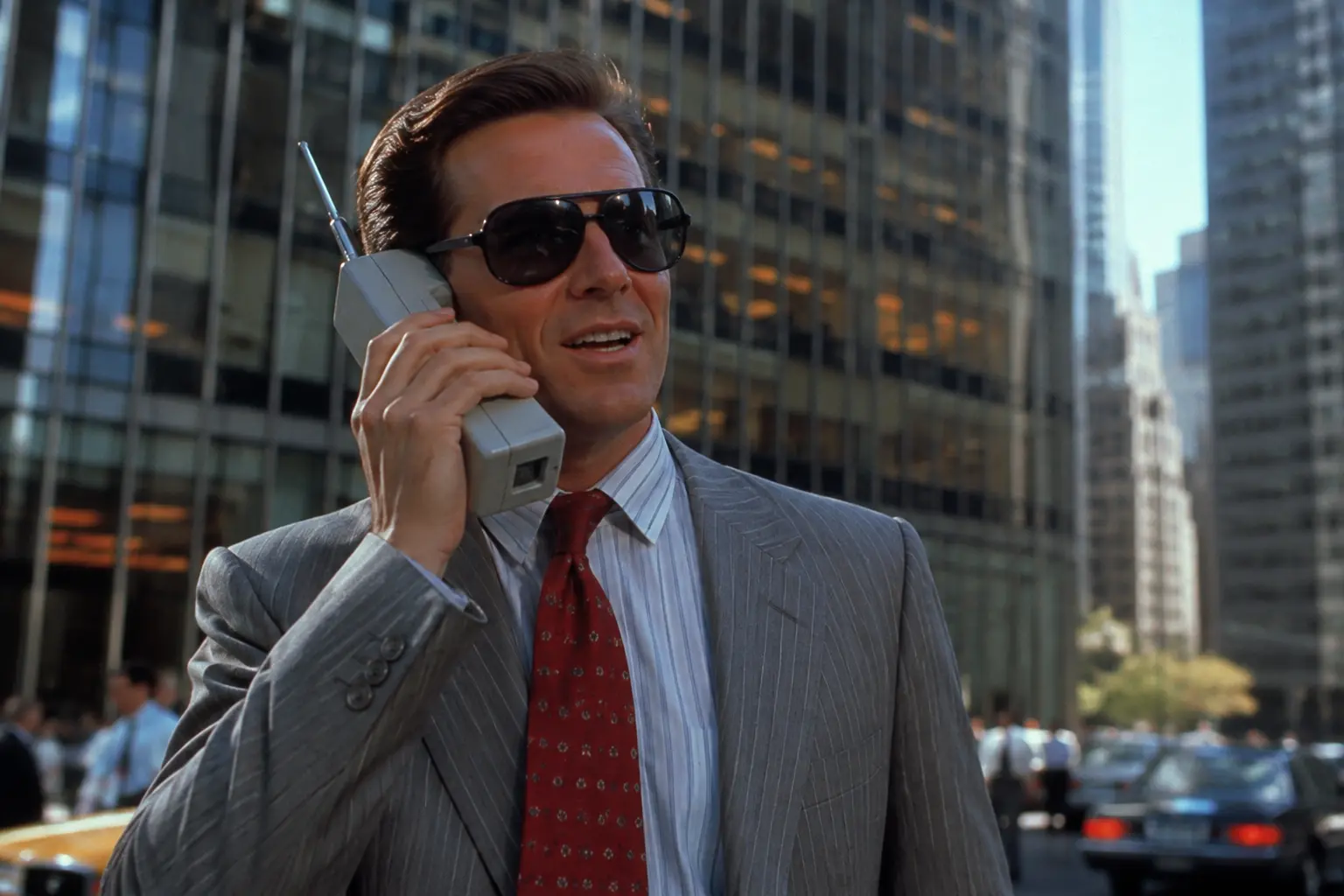
Long before smartphones slid seamlessly into our back pockets, before instant messaging, touchscreen apps, or high-definition mobile video streaming, making a call on the move required sitting inside an expensive luxury automobile fitted with a hardwired car phone. In 1983, one device changed that reality forever. The Motorola DynaTAC 8000X—affectionately known simply as "The Brick"—severed the physical wire connecting human speech to fixed locations. It was heavy, astronomical in price, and offered barely half an hour of talk time, but it ignited a technological revolution that permanently reshaped human society.
The Vision: Untethering Communication
To understand the sheer audacity of the Motorola DynaTAC 8000X, one must travel back to the early 1970s. Telephones were tethered to walls by curly cords, and telephone service in the United States was dominated by AT&T's monolithic Bell System. AT&T had spent decades developing mobile concept telephony, but their focus was strictly on car-based communication—heavy radio transmitters mounted inside vehicle trunks that tapped into car batteries.
Engineers at Motorola, led by Vice President and Division Manager John F. Mitchell and Chief Engineer Martin Cooper, harbored a vastly different vision. They believed people didn't want to call a place, a desk, or an automobile—they wanted to call another person.
In late 1972, Cooper spearheaded a crash project to build a working prototype of a truly portable, hand-held cellular phone. Over an intense 90-day sprint, the engineering team designed, built, and assembled a functional prototype.
April 3, 1973: The Call That Changed the World
On April 3, 1973, Martin Cooper stepped onto the sidewalk of Sixth Avenue in New York City, holding a beige device roughly the size and weight of a domestic building brick. Surrounding him were reporters, photographers, and curious onlookers.
Cooper dialed a number. The radio signal bounced off a temporary base station installed atop the Burlington House (now the AllianceBernstein Building) and crossed into the AT&T landline network. On the other end of the line answered Joel S. Engel, head of AT&T’s rival cellular research program at Bell Labs.
"Joel, this is Marty," Cooper famously announced. "I'm calling you from a cell phone, a real handheld portable cell phone."
It was a masterstroke of corporate theater and a historic technological milestone. Yet, turning that prototype into a commercial product ready for public consumption would prove to be a daunting, decade-long marathon.
📟 Hardware Heritage
The name DynaTAC was an acronym for Dynamic Adaptive Total Area Coverage. The development program cost Motorola over $100 million between 1973 and 1983 long before a single unit was commercially sold.
A Decade in Regulatory and Engineering Limbo
While the 1973 prototype proved handheld mobility was possible, commercially launching the system required overcoming massive technological, logistical, and political hurdles.
First, Motorola had to miniaturize hundreds of components. The 1973 prototype used hand-soldered circuit boards and custom micro-electronics that were far too delicate and expensive for mass manufacturing. Motorola engineers had to design custom integrated circuits, ultra-compact radio frequency (RF) amplifiers, and long-lasting rechargeable batteries.
Second, the infrastructure didn't exist. Cell phone towers had to be constructed, frequencies allocated, and underlying cellular switching algorithms created so calls could seamlessly handed off from one tower cell to another as a user moved through a city without dropping the connection.
Finally, Motorola faced fierce regulatory battles with the Federal Communications Commission (FCC) and AT&T over spectrum allocation. It took ten full years of testing, lobby work, and engineering refinements before the FCC finally granted commercial approval for Motorola's cellular network and hardware in September 1983.
Commercial Launch and Mind-Boggling Specs
Following FCC approval in September 1983, the Motorola DynaTAC 8000X became the world's first commercially available handheld cellular phone.
- Dimensions: 13 x 1.75 x 3.5 inches (33 x 4.5 x 8.9 cm) without counting the flexible rubber whip antenna.
- Weight: approximately 2.5 pounds (1134 grams)
- Talk Time: Just 30 minutes per charge.
- Standby Time: Approximately 8 to 10 hours.
- Charging Time: 10 hours on standard trickle charge (or 1 hour via an optional desktop fast charger that ran extremely hot).
- Display: A minimalist red LED digit display that showed dialed phone numbers.
- Memory: Stored up to 30 telephone numbers in its internal memory.
The price tag was equally stunning. The DynaTAC 8000X went on sale for $3,995—the equivalent of over $11,000 to $12,000 today when adjusted for inflation. On top of the hardware purchase price, owners had to pay monthly service fees and steep per-minute airtime charges that routinely totaled hundreds of dollars each month.
Despite the exorbitant cost, thousands of eager buyers lined up on waiting lists to get their hands on one.
The Ultimate 1980s Status Symbol
The DynaTAC 8000X instantly transcended its functional purpose as a communication tool to become the quintessential cultural icon of 1980s prosperity, ambition, and excess.
It became the mandatory accessory for Wall Street traders, real estate moguls, high-flying executives, and Hollywood celebrities. To pull a DynaTAC out of a leather briefcase at a high-end restaurant or on a luxury yacht was the ultimate declaration that your time was so valuable, the world had to be able to reach you anywhere, at any second.
Oliver Stone immortalized the device in his classic 1987 film Wall Street. The image of Michael Douglas as corporate raider Gordon Gekko strolling along a beach at sunrise, holding a beige DynaTAC to his ear while barking orders to buy shares, stamped the "brick phone" permanently into pop culture history.
Later in the decade and into the early 1990s, characters like Zack Morris in Saved by the Bell cemented its place in television lore, making the brick phone a beloved retro classic.
"It wasn't just a phone; it was a badge of power. Holding that heavy piece of plastic told everyone in the room that you were important enough to be reached anywhere on Earth."
Under the Hood: How the First Cell Network Worked
The DynaTAC 8000X operated on 1G (first-generation) analog cellular networks, specifically using the Advanced Mobile Phone System (AMPS) standard pioneered in North America.
Unlike modern digital networks (4G LTE and 5G), AMPS transmitted voice conversations over unencrypted FM radio waves. This meant that anyone with a basic radio scanner could potentially listen in on mobile phone calls—a security vulnerability that wasn't fully addressed until 2G digital networks emerged in the 1990s.
Despite the primitive analog transmission, the underlying architecture was genius. The service area was divided into hexagonal "cells," each serviced by a base station tower. As a user moved, the system automatically monitored signal strength and transferred the call from cell tower to cell tower without interrupting the conversation—the fundamental principle that powers every modern mobile network today.
The Evolution of the DynaTAC Line
The 8000X was only the beginning. Motorola quickly iterated on the design throughout the rest of the 1980s, releasing several successor models in the DynaTAC series:
- DynaTAC 8000s (1985): Introduced minor internal improvements and slightly refined power management.
- DynaTAC 8500x (1987): Featured an updated design, extra key functions, and extended battery performance.
- DynaTAC 8900x (1989): Introduced a sleek flip cover over the keypad and better battery options.
- Ultra Classic Series (1990s): Reduced overall weight while retaining the classic brick silhouette, catering to nostalgic users and harsh industrial environments.
Eventually, Motorola shifted focus toward miniaturization, introducing the pocketable MicroTAC flip phone in 1989 and the legendary StarTAC wearable phone in 1996, rendering the giant brick style obsolete for mainstream users.
The Lasting Legacy of "The Brick"
Today, the Motorola DynaTAC 8000X sits proudly in museum exhibits alongside the Gutenberg printing press, the Ford Model T, and the Apple I computer as a true watershed moment in human history.
It transformed the concept of telecommunication from a spatial activity bound to homes and offices into a personal attribute tied directly to an individual. It laid the foundation for an industry that today connects billions of people, powers global commerce, and puts the sum total of human knowledge into handheld devices.
Though its 30-minute battery life and two-pound frame seem humorous today, we live in a world built entirely on the foundation laid by Martin Cooper, John F. Mitchell, and the visionaries at Motorola who dared to build a phone you could carry in your hand.
💬 Community Discussion
Share your memories of the 80s. Every comment is reviewed before appearing.
Leave a Comment
💬 Recent Comments