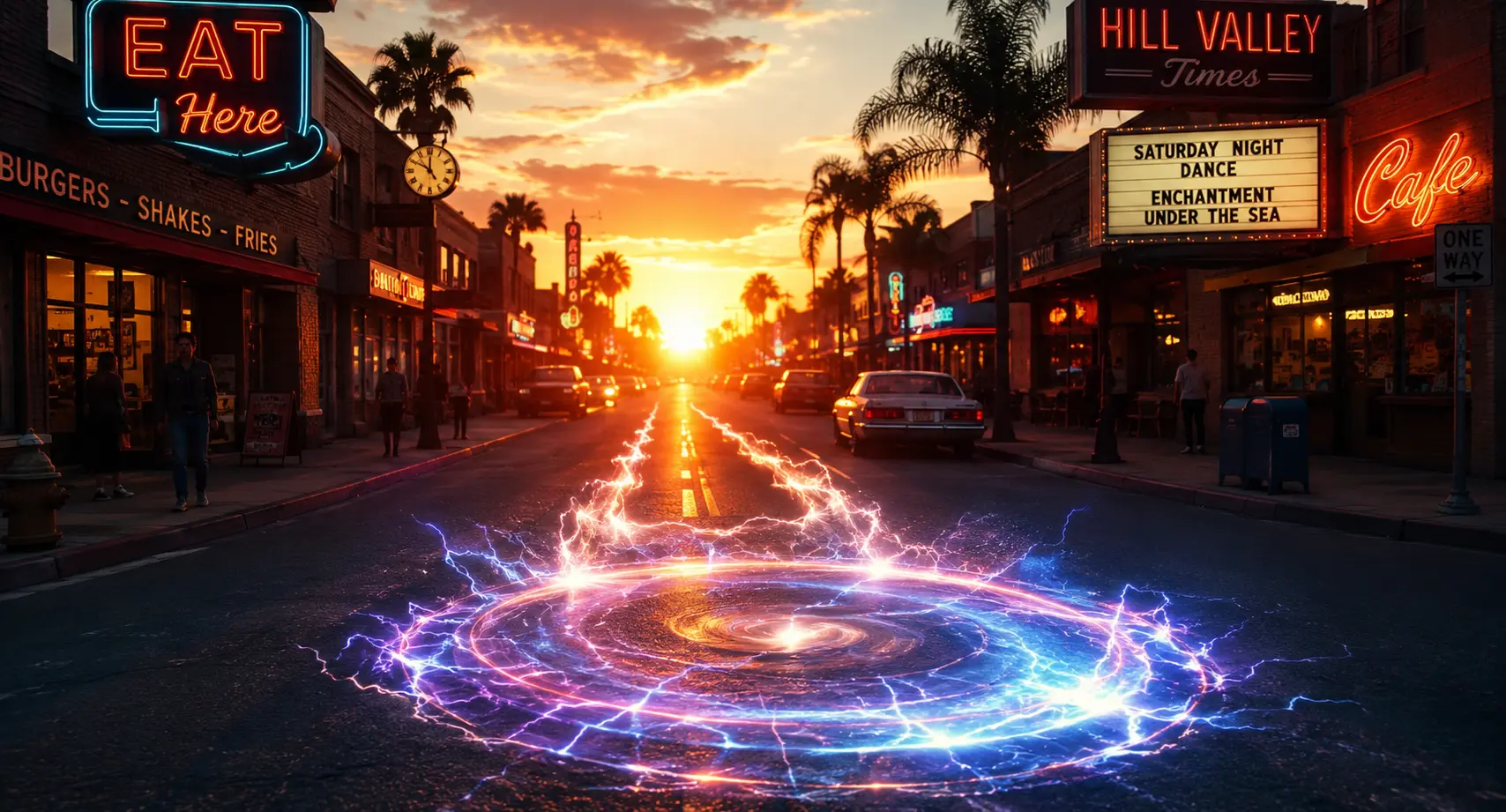
In the summer of 1985, a sci-fi adventure blended humor, heart, and memorable characters into a film that would define a generation. But behind its iconic status lies a story of rejection, perseverance, and Hollywood surprises.
Part 1 — From Rejected Script to Hollywood Classic
An Idea Born from a Family Photo
The seeds of Back to the Future were planted years before cameras began rolling. Writer Bob Gale was visiting his parents when he stumbled across his father's high school yearbook. Curious, he flipped through the pages and discovered that his father had served as class president. The discovery sparked an unexpected question. If Bob Gale had attended school at the same time as his father, would they actually have been friends? It was an intriguing thought. Children often imagine their parents as adults who have always existed in that role, but every parent was once a teenager with hopes, insecurities and dreams of their own. That simple question became the emotional heart of the entire movie. Instead of creating another science-fiction story about changing history, Gale imagined a teenager who accidentally travels into the past and meets his own parents before they fall in love. It was a brilliant twist because it blended fantasy with something deeply personal. The concept wasn't just about time travel. It was about family.
A Partnership That Changed Hollywood
Bob Gale had spent years working alongside director Robert Zemeckis. The pair met while studying film at the University of Southern California and quickly became close collaborators. Both loved classic cinema, imaginative storytelling and movies that mixed humour with emotion. Throughout the late 1970s and early 1980s they worked together on several projects, but success proved elusive. Although they had written 1941 for Steven Spielberg, the film received mixed reviews. Other projects struggled commercially, leaving both men with a reputation as talented filmmakers who simply couldn't produce a major hit. Hollywood can be unforgiving. One unsuccessful movie often makes studios nervous about financing the next one. That reputation would soon make selling Back to the Future even more difficult.
Hollywood Says "No"
Today, it seems impossible to imagine anyone rejecting Back to the Future. But during the early 1980s, nearly every major studio passed on the screenplay. Executives offered a variety of reasons. Some thought the story was too complicated. Others believed audiences wouldn't understand a comedy built around time travel. Several studios felt it wasn't edgy enough. Teen comedies of the era such as Porky's were making huge profits, and executives wanted films filled with outrageous humour rather than family adventure. Disney, meanwhile, rejected the screenplay for exactly the opposite reason. Executives reportedly felt that the storyline involving Marty accidentally attracting the romantic attention of his future mother was too risky for a family audience. The film found itself in an unusual position. It wasn't outrageous enough for one studio. It wasn't safe enough for another. As rejection followed rejection, many writers might have abandoned the project entirely. Bob Gale and Robert Zemeckis refused.
Steven Spielberg's Belief and the Turning Point
Fortunately, the pair had an important supporter. Steven Spielberg had admired their work for years. Although he couldn't immediately help secure the film, he remained convinced the screenplay had enormous potential. Everything changed in 1984. Robert Zemeckis directed Romancing the Stone, starring Michael Douglas and Kathleen Turner. The adventure became both a critical and commercial success, transforming Zemeckis almost overnight from an unreliable director into one of Hollywood's hottest talents. The script that studios had ignored for years suddenly looked much more attractive. Universal Pictures agreed to finance the project, with Spielberg serving as executive producer through his Amblin Entertainment company. After years of rejection, Back to the Future finally had its green light. The hardest part, however, was still ahead.
Finding the Perfect Marty
From the very beginning, Robert Zemeckis and Bob Gale had only one actor in mind for Marty McFly. Michael J. Fox. By 1984, Fox had become one of America's biggest television stars thanks to the hugely successful sitcom Family Ties. Playing the ambitious and quick-witted Alex P. Keaton, he had won audiences over with his natural charm, impeccable comic timing and endless energy. Those same qualities made him seem like the perfect Marty McFly. Fox had the ability to deliver comedy without trying too hard. He could make a sarcastic remark sound effortless one moment and portray genuine fear or emotion the next. Zemeckis believed that balance was exactly what the film needed. Unfortunately, there was one major obstacle. Fox's filming schedule. Family Ties had become one of NBC's highest-rated shows, and producer Gary David Goldberg depended heavily on his young star. The television series filmed during weekdays, leaving almost no time for another major project. Zemeckis repeatedly asked if Fox could be released to make the film. The answer was always the same. No. With the production date approaching and no guarantee that Fox would become available, the filmmakers reluctantly accepted that they needed someone else.
Enter Eric Stoltz
The search eventually led to Eric Stoltz. Unlike Fox, Stoltz had developed a reputation as a serious dramatic actor. His performances were thoughtful, emotional and deeply committed. He looked the right age. He resembled the Marty McFly described in the screenplay. He impressed everyone during auditions. Universal approved the casting, and production officially began in late 1984. For weeks, everything appeared to be going according to plan. Entire scenes were completed. Complex special effects were filmed. The DeLorean sequences were captured. Sets were dressed. Hundreds of crew members worked around the clock. Millions of dollars were already being spent. There was only one problem. Something wasn't working.
A Different Interpretation
Eric Stoltz wasn't giving a bad performance. In fact, many crew members later admitted he was an exceptionally talented actor. The issue was that he was making a completely different movie. Stoltz approached Marty McFly as a realistic teenager trapped in an impossible situation. He played the role with genuine anxiety and emotional seriousness. Robert Zemeckis had imagined something entirely different. He wanted an adventurous comedy. The audience needed to laugh with Marty. They needed to enjoy his quick wit, nervous humour and teenage confidence. Instead, scenes often felt tense. Even jokes that had looked hilarious on paper suddenly landed without much impact. Christopher Lloyd, who played Doc Brown, later recalled that Stoltz remained intensely in character between takes. Rather than relaxing with the crew, he often continued behaving as Marty McFly throughout the day. His commitment was admirable. But the chemistry simply wasn't there.
The Bold Decision to Recast
As filming continued, Robert Zemeckis faced an impossible choice. The production had already been underway for several weeks. Dozens of expensive scenes had been completed. Entire sets had been built. Visual effects work had begun. Replacing the lead actor would cost a fortune. Yet every day Zemeckis became more convinced that the movie wasn't reaching its potential. Bob Gale felt the same way. So did executive producer Steven Spielberg. Quiet discussions began behind closed doors. Could they really replace the star of the movie after weeks of filming? It was almost unheard of in Hollywood. Changing a lead actor after principal photography had begun risked delaying the production, increasing costs dramatically and damaging morale. But the alternative was even worse. Completing a film that simply didn't feel right. Eventually the filmmakers reached a painful conclusion. The movie needed a different Marty McFly.
Starting Again
Eric Stoltz was informed that the production was moving in another direction. Although the decision has become legendary, those involved have often described it as one of the most difficult moments of their careers. No one doubted Stoltz's talent. He simply wasn't the Marty the filmmakers had imagined. Today, film historians often describe the situation as one of the boldest creative decisions ever made by a major Hollywood studio. Universal was effectively agreeing to throw away weeks of completed footage and spend millions of dollars filming it all again. It was a huge gamble. If the replacement failed, the production could become one of Hollywood's most expensive disasters.
Michael J. Fox Gets the Call
Almost immediately after Eric Stoltz left the project, Robert Zemeckis contacted Gary David Goldberg once again. This time, circumstances had changed. The producers of Family Ties had adjusted their filming schedule. After careful negotiation, Goldberg agreed to allow Michael J. Fox to make the movie—as long as television remained his first priority. Fox accepted instantly. He had loved the screenplay from the moment he'd read it and was disappointed he'd originally had to decline. Now he finally had the opportunity. There was only one catch. His schedule would be almost impossible.
Two Full-Time Jobs
Michael J. Fox's routine during production has become one of Hollywood's most famous work schedules. Each weekday began early in the morning on the set of Family Ties. He spent the entire day filming episodes for the sitcom, often working until around 6:00 p.m. Instead of going home to rest, he climbed into a car and headed straight across Los Angeles to the Back to the Future set. There, another working day was just beginning. Filming often continued until two or three o'clock in the morning. Sometimes even later. Fox would grab only a few hours of sleep before returning to the television studio to repeat the entire process again. For months, this became his normal routine. Weekends were devoted entirely to the movie, allowing longer shooting days while the sitcom was on break. It was exhausting. Yet remarkably, Fox rarely complained. His boundless energy became one of the defining characteristics of the production. Many cast and crew members later said they couldn't understand how he kept going.
Part 2 — Crafting the Time Machine and Iconic Elements
The DeLorean: A Car from the Future
The DeLorean DMC-12. Today it's impossible to separate the movie from the car, but surprisingly, the DeLorean wasn't part of the original screenplay. Bob Gale and Robert Zemeckis initially imagined Doc Brown's time machine as something entirely different—a laser-powered device hidden inside an ordinary household refrigerator. The idea certainly looked unique on paper. Marty would climb inside the refrigerator, Doc would activate the machine, and the appliance would transport him through time. There was just one problem. Steven Spielberg raised an important concern. Children often climbed inside discarded refrigerators while playing, something that had led to tragic accidents over the years. Spielberg worried that young fans might imitate the movie after seeing it. The filmmakers agreed. The refrigerator idea was abandoned before filming began. That decision may have saved more than just the script—it probably prevented countless dangerous accidents. Now the filmmakers needed another way to travel through time. Something exciting. Something believable. Something audiences had never seen before.
The Flux Capacitor and the Magic of Time Travel
If the DeLorean became the body of the time machine, the Flux Capacitor became its heart. Hidden behind the driver's seat, the glowing Y-shaped device pulsed with electricity whenever time travel approached. The name itself sounded wonderfully scientific despite meaning absolutely nothing. According to Bob Gale, he came up with the phrase almost by accident while writing the screenplay. Rather than filling the script with complicated scientific explanations, he invented a mysterious component that audiences simply accepted. Ironically, the fictional invention became so famous that many people later believed it was based on real scientific theory. Replica Flux Capacitors are now among the most popular pieces of movie memorabilia in the world.
Recreating Hill Valley
Just as important as the DeLorean was the town it travelled through. Hill Valley feels like a real American community because much of it was built around Universal Studios' famous courthouse square backlot. The location had appeared in countless television shows and films over the years, but Back to the Future transformed it completely. Shop fronts were redesigned. Street signs changed. Classic cars filled the roads. Hundreds of extras dressed in period clothing recreated small-town America during the 1950s. The production team effectively built two versions of the same town. One represented 1985. The other recreated 1955. Although the layouts remained almost identical, subtle differences helped audiences understand how much had changed over thirty years. The once-proud courthouse looked worn in 1985. Businesses had changed. The town seemed quieter. When Marty arrived in 1955, however, Hill Valley felt vibrant, optimistic and full of possibility. That contrast became one of the movie's greatest visual achievements.
Special Effects and Practical Magic
Modern audiences are accustomed to computer-generated visual effects. In 1985, those tools barely existed. Almost everything seen on screen had to be created using practical effects, clever camera work and old-fashioned movie magic. The glowing trails of fire left behind by the DeLorean? Real burning tyre tracks created under carefully controlled conditions. The electrical bolts surrounding the car? A combination of animation techniques layered onto the film after shooting. The flashes of light? Special lighting rigs positioned around the vehicle. The disappearing car? Multiple passes of the camera combined into a single shot. Each effect required careful planning. There was no instant digital preview. If something didn't work, the crew often had to film the entire sequence again. Considering those limitations, many of the visual effects still hold up remarkably well today. Rather than relying on computers, the filmmakers relied on creativity.
The Soundtrack and Music
Imagine Back to the Future without its music. It's almost impossible. Composer Alan Silvestri created one of the most triumphant orchestral scores of the 1980s. His main theme perfectly captured the movie's sense of adventure. The music could become playful during comedy scenes, emotional during family moments and breathtaking during the film's spectacular climax. Ironically, Universal executives initially questioned whether such a grand orchestral score suited a comedy. Fortunately, Robert Zemeckis trusted Silvestri's instincts. He believed the characters treated their situation seriously, even if audiences laughed. The music reflected that sincerity. The result elevated the entire film. Today, only a few notes are needed before audiences immediately recognise the score.
Ronald Reagan Notices
The film's popularity soon reached the highest levels of American politics. One line in particular delighted President Ronald Reagan. Near the end of the movie, Doc Brown reacts with disbelief after learning that Ronald Reagan is President in 1985. "Ronald Reagan? The actor?" The joke reflected Reagan's earlier career as a Hollywood actor before entering politics. According to several accounts, President Reagan enjoyed the joke so much during a private White House screening that he reportedly asked the projectionist to rewind the scene so everyone could watch it again. Months later, while delivering his State of the Union Address, Reagan surprised audiences by quoting another memorable line from the movie: "Where we're going, we don't need roads." It was an extraordinary moment. A fictional adventure film had become part of the cultural conversation at the very highest level.
Part 3 — The Film’s Success and Cultural Impact
Box Office Triumph and Critical Acclaim
After months of overnight filming, expensive reshoots and relentless editing, Back to the Future was finally ready for audiences. Universal Pictures released the film in the United States on July 3, 1985, perfectly timed for the busy Independence Day holiday weekend. Summer was already becoming the biggest season for blockbuster releases, and competition was fierce. Big-budget action films, comedies and family adventures were all battling for cinema audiences. Even Universal wasn't entirely certain what to expect. Science fiction had enjoyed enormous success with films like Star Wars, but Back to the Future wasn't a straightforward space adventure. It mixed comedy, romance, teenage drama and time travel into something that felt completely original. Would audiences embrace such an unusual combination? Within days, the answer became clear. Moviegoers loved it.
Its Enduring Legacy
By the time Back to the Future completed its remarkable theatrical run, one thing had become obvious. The film had achieved something incredibly rare. It wasn't simply a successful movie. It had become a cultural landmark. Children dreamed of owning a DeLorean. Fans quoted Doc Brown's catchphrases. Tourists visited filming locations. Replica time machines appeared at conventions around the world. And decades later, new generations continue discovering the film for the very first time. For a movie that almost never got made, it had achieved immortality. But even after nearly forty years, there are still dozens of fascinating behind-the-scenes stories, hidden details and surprising facts that many fans have never heard. Those final secrets are worth one last trip through time.
Pop Culture Icons
Very few movies have contributed so many instantly recognizable images to popular culture. The stainless-steel DeLorean. Marty's orange puffer vest. Doc Brown's wild white hair. The glowing Flux Capacitor. The digital speedometer racing toward 88 mph. The Hill Valley clock tower. The hoverboard. "Great Scott!" "Roads? Where we're going, we don't need roads."
The DeLorean’s Second Life
Once a struggling car, the DeLorean became an automotive legend thanks to the film. Restored models are showcased at conventions and events, with enthusiasts recreating the iconic time machine down to the last detail.
Predictions and Reality
While we still don't have flying cars or practical hoverboards, the film got more right than many expected: Video calls. Large flat-screen televisions. Wearable technology. Biometric devices. Voice-controlled assistants. Tablet computers. It turns out the future imagined in 1985 wasn't entirely fantasy after all.
Final Thoughts
"Back to the Future" is more than a summer blockbuster; it’s a timeless story about family, adventure, and believing in second chances. Its journey from rejection to cultural treasure exemplifies the power of perseverance, creativity, and trusting your instincts.
Decades later, it continues to inspire new generations of filmmakers and fans, reminding us all that the greatest adventures often come from the most unexpected beginnings.
💬 Community Discussion
Share your memories of the 80s. Every comment is reviewed before appearing.
Leave a Comment
💬 Recent Comments