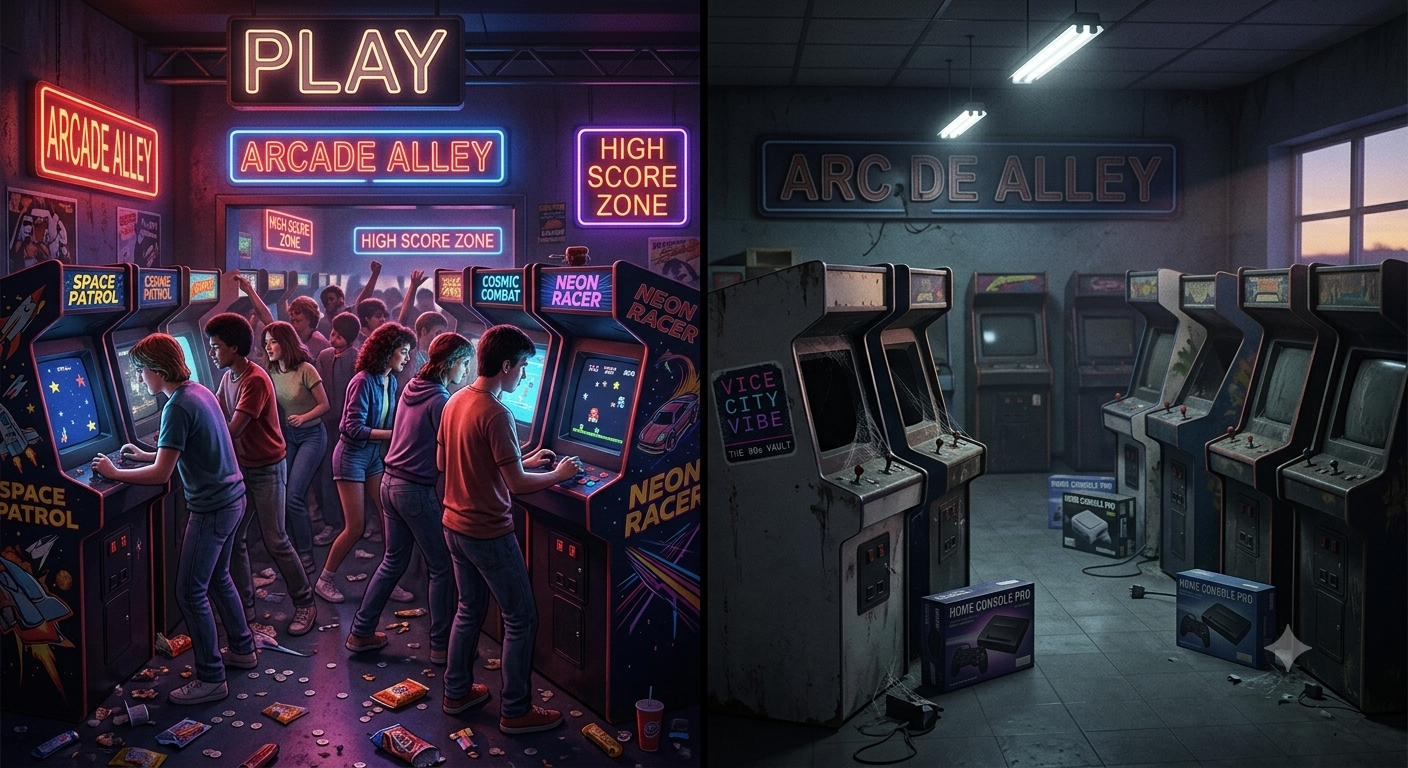
Long before voice chat, online multiplayer and downloadable games, there was only one place where the latest gaming experiences could be found: the local arcade. Every shopping centre, seaside town and city high street seemed to have one. You could hear them before you even walked through the door—the constant soundtrack of electronic explosions, jingles, cheering players and the unmistakable clink of coins dropping into machines.
For millions of children and teenagers, arcades weren't simply somewhere to play games. They were meeting places, competition arenas and technological showcases rolled into one. During the 1980s they became one of the defining symbols of youth culture.
The Golden Age Begins
Although arcade games had existed during the 1970s, everything changed with the arrival of games like Space Invaders in 1978. Suddenly people weren't just casually playing—they were queuing for their turn.
The real explosion came in the early 1980s.
Titles such as Pac-Man, Donkey Kong, Galaga, Defender, Frogger and Centipede became worldwide sensations. Every few months seemed to bring another revolutionary machine that everyone simply had to try.
Did You Know?
At their peak in the early 1980s, arcade machines generated more revenue than the Hollywood box office.
More Than Just Games
Walking into an arcade was unlike entering any other building. The rooms were usually dark, illuminated almost entirely by colourful CRT monitors. Neon signs glowed overhead while rows of cabinets stretched into the distance.
Every machine had its own personality.
Some featured racing seats. Others had steering wheels, flight sticks or oversized trackballs. The artwork decorating each cabinet was almost as exciting as the games themselves, making every machine feel like its own miniature attraction.
"You didn't just play an arcade game—you stepped inside its world."
The Quarter Economy
Unlike modern gaming subscriptions, every attempt came at a price.
Whether you carried quarters, 10p pieces or tokens depending on where you lived, every life mattered because every mistake literally cost money.
Good players could make a handful of coins last all afternoon.
Less experienced players could watch their week's pocket money disappear in twenty minutes.
High Scores Meant Everything
Modern games reward players with achievements and trophies, but arcade players chased something much simpler—the high-score table.
Seeing your initials sitting proudly at the top of the screen meant everyone who walked up afterwards knew someone had mastered that machine.
Those three letters became a badge of honour.
Friendly rivalries often developed between classmates as players battled for bragging rights rather than physical prizes.
The Social Hub of the 1980s
Arcades were among the few places where large groups of teenagers naturally gathered without organised activities.
Friends would watch each other's games, offer advice, cheer impossible victories and groan when somebody lost on the final level.
Sometimes ten people crowded around one machine watching a skilled player perform what seemed like magic.
Long before YouTube or Twitch, live spectatorship was already part of gaming culture.
Technology That Seemed Like Magic
Every new arcade cabinet demonstrated technology that home consoles simply couldn't match.
The graphics were sharper.
The sound was louder.
The controls were more responsive.
Games like Out Run, After Burner and Hang-On even featured moving cabinets that tilted with the action, making players feel as though they were inside the game itself.
Arcade Innovation
Many gaming technologies—including force feedback, motion cabinets and multiplayer linking—appeared in arcades years before they reached living rooms.
Then Came the Home Console Revolution
By the late 1980s things began to change.
The Nintendo Entertainment System brought high-quality gaming into millions of homes, while Sega pushed technology even further with the Mega Drive.
Suddenly players no longer needed to leave the house to enjoy excellent games.
Buying one cartridge offered hundreds of hours of entertainment for less than players might spend feeding coins into arcade machines over several weekends.
The Slow Decline
During the 1990s arcades still produced classics such as Street Fighter II, Mortal Kombat, Daytona USA and Time Crisis, but fewer dedicated arcades survived each passing year.
Home consoles continued improving.
Personal computers became more powerful.
Eventually online gaming connected players across the world without requiring anyone to leave home.
Many beloved arcades quietly closed their doors forever.
Why We Still Miss Them
Modern gaming is undoubtedly more convenient, but something unique disappeared alongside the arcades.
You can't recreate the excitement of walking into a room filled with dozens of strangers all sharing the same hobby.
You can't replace the feeling of waiting your turn while balancing a coin on the edge of the cabinet to claim "next game."
And no online leaderboard quite captures the satisfaction of seeing your initials glowing at the top of an actual machine.
The Legacy Lives On
Today, retro arcades, gaming museums and barcades are keeping the spirit alive. Classic cabinets are being restored, collectors are preserving original hardware and younger generations are discovering why these machines became cultural icons.
For those who grew up during the 1980s, however, arcades will always represent something much bigger than gaming.
They were places where friendships were made, rivalries were born and unforgettable memories were created—one coin at a time.